Friction Pendulum and Sliding Isolation Systems Explained
Where Sliding Systems Fit in Seismic Isolation
Seismic isolation reduces the earthquake forces a building has to carry by inserting a flexible, energy dissipating layer between the structure and the ground. Two families of hardware dominate the field. Elastomeric bearings, laminated rubber devices such as the lead rubber bearing, came first: the first rubber isolated building was completed in Skopje in 1969, the lead rubber bearing was invented in New Zealand in 1975, and the first isolated building in the United States, the Foothill Communities Law and Justice Center of 1985, sits on high damping rubber bearings. Sliding systems, the subject of this article, arrived as the second family and matured through the late 1980s and 1990s.
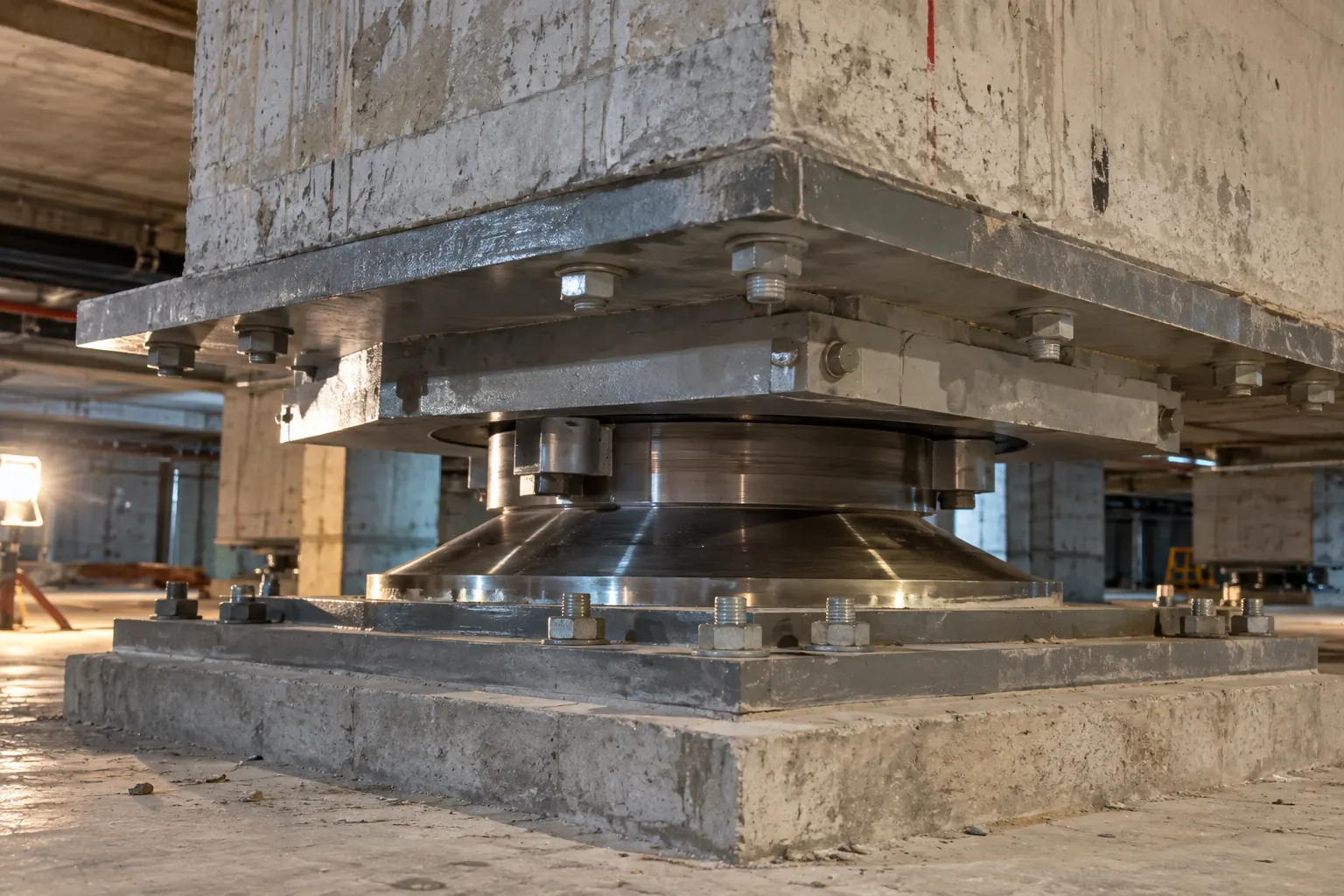
A curved surface slider, best known under the trade name Friction Pendulum, carries the building on an articulated slider that rests in a polished concave dish. When the ground moves, the slider travels across the curved surface. Gravity supplies a restoring force that pushes the building back toward the center, and friction at the sliding interface dissipates energy. Neither family is the default answer for every project. What fits depends on loads, displacement demand, site conditions and procurement realities. This article deals with the sliding side of that choice.
How Curved Surface Sliders Work
Think of a ball resting in a bowl. Push it to one side and gravity pulls it back toward the bottom. A friction pendulum bearing applies the same mechanics at building scale: the concave dish is the bowl, and the supported column load is what gravity pulls back to center.
The Pendulum Period
The defining property of the pendulum mechanism is that the sliding period depends on the geometry of the dish, not on the mass it carries:
T = 2π√(R/g)
- T = pendulum period of the sliding phase (seconds)
- R = effective radius of curvature of the sliding surface (meters)
- g = gravitational acceleration (9.81 m/s²)
An effective radius of 5 meters gives a pendulum period of about 4.5 seconds. That formula needs two caveats. It describes only the sliding phase: because friction adds resistance, the effective period of the real bearing depends on displacement amplitude, and engineers design with effective stiffness at the design displacement rather than the ideal pendulum value. Mass independence, for its part, holds in theory: geometry alone sets the pendulum term. In practice the friction term rides along with it, and friction varies with contact pressure, sliding velocity, and temperature, so the real response is not fully load independent either. It remains a genuine advantage in buildings whose weight distribution is uncertain or changes over time, just not the absolute one the textbook formula suggests.
The purpose of lengthening the period is decoupling. Most ground motions concentrate their energy at short periods, and shifting the system period well away from the predominant period of the expected ground motion is what cuts the accelerations transmitted into the structure. Site conditions matter here: on soft soils with long period motion content, the target period has to be chosen with more care, which is one of several reasons isolation design is site specific.
Friction: the Damping, and the Fine Print
Friction at the sliding interface is the energy dissipator. Design friction coefficients for building isolators are typically specified in the range of a few percent up to about 10 percent, and the exact value is a project decision proven by prototype testing rather than a material constant.
The fine print matters more than most introductory articles admit. The coefficient of friction of a sliding bearing is not one number. It is set first by the liner material itself, each material family has its own characteristic range, and then it varies with sliding velocity, with contact pressure, and with temperature, dropping as the interface heats up during long or repeated sliding. This behavior has been characterized in detail since the laboratory work of Mokha, Constantinou, and Reinhorn around 1990, and modern analysis models represent friction as a function of these variables, including the frictional heating that develops in a long duration earthquake. The good news is that designers are not starting blind: the established liner materials have been through decades of testing across many programs, and manufacturers publish characterization curves showing how friction moves with pressure and velocity for each material. Prototype tests are run for each project to confirm those values on the actual bearing design; that said, when a manufacturer has already tested bearings of similar size under similar loads and displacements on a previous project, codes allow the engineer of record to accept those existing results, which saves both testing time and money. A specification that quotes a single friction number without stating the material and the velocity, pressure, and temperature conditions behind it is still incomplete.
The sliding interface itself pairs a stainless steel surface with an engineered polymer liner. Early bearings used PTFE, and the literature still says "Teflon" as shorthand, but current commercial curved surface sliders run on filled PTFE composites, ultra high molecular weight polyethylene, or proprietary liner materials qualified through the manufacturer's test program. When comparing suppliers, the liner qualification data is one of the documents worth reading closely; our guide to isolator specifications and acceptance testing covers what to ask for.
A Short, Accurate History
The idea of isolating a building on curved sliding surfaces is much older than the modern product. Jules Touaillon's United States patent of 1870 already shows a building resting on balls between opposing concave surfaces, and Johannes Calantarients proposed a sliding isolation layer in 1909. What the 20th century added was the engineering. Materials that slide predictably and test programs that prove the behavior came first; the codes that regulate the result came later.
The modern friction pendulum story belongs to Victor Zayas, who founded Earthquake Protection Systems (EPS) in 1985. The concept was validated on the shake table at UC Berkeley's Earthquake Engineering Research Center using a quarter scale six story steel model, documented in report UCB/EERC-87/01 in 1987, with the journal presentation by Zayas, Low, and Mahin following in Earthquake Spectra in 1990. From there the technology moved into bridges and buildings through the 1990s, with the San Francisco International Airport terminal, completed in 2000 on 267 friction pendulum bearings, as the landmark early building application.
The order of events gets told backwards often enough to be worth stating plainly: rubber isolation was in service first, and sliding isolation joined it. Both families now have decades of installations and real earthquake performance behind them.
Single, Double, and Triple Pendulum Bearings
Single Pendulum
The original configuration has one concave surface and one slider. It is simple and well understood. Its main limitation is geometric: the displacement capacity of the bearing is bounded by the size of the single dish, so large design displacements demand a physically large bearing.
Double Concave
A double concave bearing has two facing dishes with the slider between them, so the total displacement demand is shared between two surfaces. That allows a more compact bearing in plan for the same displacement capacity, and the two radii and two friction coefficients can differ, which gives the designer more freedom in shaping the force displacement loop. The concept itself is old, visible already in Touaillon's 1870 patent; the rigorous characterization of its behavior that made modern design practical was published by Fenz and Constantinou in 2006.
Triple Pendulum
The triple pendulum bearing, characterized in the research literature in 2008, nests an inner slider assembly between two main concave surfaces, creating multiple sliding stages. The practical result is adaptive behavior: the bearing presents different effective stiffness and friction at different displacement amplitudes, so it can be configured to respond gently in frequent, moderate shaking and to control displacement and stiffen in rare, extreme shaking. Morgan and Mahin's 2010 study documents this multilevel performance rationale. Turkey's largest isolation projects, including hospital projects and the Sabiha Gokcen airport terminal, use this generation of hardware.
A clarification is needed here, because the claim shows up in a lot of marketing copy: adding surfaces does not make friction independent of load, and it does not by itself solve frictional heating. Pressure and velocity dependence of friction is a property of the liner material at every interface. What multiple surfaces genuinely buy is displacement capacity in a compact bearing and staged, tunable behavior.
Recentering: What Is Actually Guaranteed
Sliding system literature often presents recentering as automatic. The truth is more conditional, and it is written into the codes. A sliding bearing recenters only if the restoring force from its curvature exceeds the residual friction force; a large radius dish with relatively high friction can leave the building with a permanent offset after the earthquake. This is exactly why ASCE 7-22 Section 17.2.4.4 requires every isolation system, sliding or elastomeric, to demonstrate a minimum restoring force: the lateral force at the total design displacement must exceed the force at half that displacement by at least 2.5 percent of the seismic weight. The Turkish code TBDY 2018 carries an equivalent requirement in Section 14 and additionally caps the period computed with the second slope stiffness at 6 seconds.
Elastomeric bearings, for their part, recenter through the elasticity of the rubber itself and do this well. So the honest comparison has nothing to do with "sliders recenter, rubber does not." Both families are designed to meet the same restoring force requirement, and in both cases the designer has to check residual displacement, especially for near fault sites with pulse type motions.
Friction Pendulum vs Lead Rubber Bearings
The most common design decision is between curved surface sliders and lead rubber bearings. We compare the two families in depth in our LRB vs FPS comparison; the short version is below.
| Criterion | Curved surface slider (FPS) | Lead rubber bearing (LRB) |
|---|---|---|
| Working principle | Sliding on a concave surface; gravity restores, friction damps | Rubber flexibility; plastic yielding of the lead core damps |
| Isolation period | Set by surface geometry, independent of supported mass | Depends on bearing stiffness and supported mass |
| Damping source | Interface friction; varies with velocity, pressure, temperature | Lead core yielding; stable, well characterized over decades |
| Recentering | Geometric; must satisfy code restoring force minimum, residual offset possible with large radius and high friction | Rubber elasticity; must satisfy the same code minimum, and does so reliably |
| Vertical load | High pressures on the steel liner interface allow very large loads in a low height unit; note the compactness is vertical, since in plan the dish must be wide enough for the full design displacement | Larger plan area needed as loads grow; buckling stability governs |
| Displacement capacity | Large, especially in double and triple configurations | Limited by rubber shear strain; large demands need large bearings |
| Track record | In service since the 1990s; strong recent field validation | In service since the early 1980s; the most widely installed isolator type worldwide |
| Service life and maintenance | Standards assign no fixed lifespan in years to either type. Both are qualified for the design life of the structure through aging and durability testing, and both rely on periodic inspection rather than scheduled replacement | |
Where do projects actually land? Sliders tend to pull ahead at the extremes: very high vertical loads, very large design displacements, uncertain or changing mass, or a height constrained isolation layer (compact vertically, though the dish still needs its plan footprint). Outside those extremes, which is to say for most buildings, lead rubber bearings compete head to head, with the longer track record and stable, well understood hysteresis on their side. The service environment deserves more attention than it usually gets, too. A sliding bearing lives or dies by the condition of its polished interface, so contamination, moisture, and corrosion of the stainless surface are recognized long term risks; this is exactly why the property modification (lambda) factors introduced by Constantinou and colleagues in 1999, and built into US practice since, make designers bound friction for aging and contamination, and why sliders are supplied sealed. Elastomeric bearings, protected by their cover rubber, are notably robust in wet, humid, or dirty service conditions, which is a real argument for LRB near water or in aggressive environments; rubber's own aging is handled by the same lambda framework. None of this reduces to a rule of thumb. The honest answer is that the choice is case by case, driven by loads, displacement demand, site, service environment, and procurement, and where both families fit, tendering both is the sensible move.
What Sliding Isolation Costs
We do not quote per unit bearing prices here, because credible ones do not exist outside a specific tender: unit costs move with bearing size, displacement capacity, testing scope, market, and order volume, and published blanket figures age badly (the supply side itself is mapped in our seismic isolation system market overview). The framing that holds up is proportional. As a working rule, seismic isolation adds roughly 10 to 15 percent to the cost of the structural shell of a new building, which corresponds to a total project premium of typically 5 to 10 percent once the isolation floor, joints, and flexible utility connections are counted in. Part of that premium is recovered through lighter superstructure framing. Our cost guide works through the full picture, and the honest comparison between slider and elastomeric options on a given project is the delivered price of tested bearings meeting the same specification, not a generic percentage between families.
Durability, Inspection, and Maintenance
One claim comes up often enough to deserve suspicion: that sliding bearings last "100+ years" while elastomeric bearings need replacement on a schedule. No isolator standard assigns a service life in years to either family. EN 15129 and the related standards require isolation devices to be qualified for the design working life of the structure through accelerated aging and durability testing, and both families routinely meet that requirement. There is no code mandated replacement schedule for either type.
What both families genuinely need is inspection: a baseline after installation, periodic visual checks on an interval set by the project specification, and an extraordinary inspection after any significant earthquake. What the inspector looks at is residual displacement, the condition of the sliding surface or rubber, and the state of connections and seals. Inspection also has a second job that gets far less attention than bearing condition: verifying that the isolation can actually work. An isolated building protects nothing if it cannot move. After the February 2023 earthquakes, a reconnaissance team from the Turkish Association for Seismic Isolation (TASI) visited all eleven isolated hospitals in the affected region and found no structural damage in any of them, but documented seismic gaps filled with soil and debris, retaining walls connected to the isolated structure, inadequate clearances that likely restricted movement, and damaged moat cover details, with nonstructural wall damage in the superstructure as the visible result. The team's immediate recommendations included specially designed movement gaps and moat covers, and making sure building users understand that the clearances must stay clear. Walls built across the moat after handover, rigid pipe or duct connections crossing the isolation plane, storage crammed into the gap: any of these quietly ties the building back to the ground. A periodic inspection that walks the full perimeter and every service crossing, before an earthquake rather than after, is what catches this. The practical questions, including what inspectors actually look for, are covered in our article on isolator lifespan and maintenance.
Codes and Testing: Who Governs What
- United States, ASCE 7-22 Chapter 17. Governs the design of seismically isolated buildings. Since the 2016 edition, isolation design is carried out at the risk targeted maximum considered earthquake (MCE_R) level. The chapter also defines the prototype and production test program for the bearings and the restoring force requirement described above.
- Europe, EN 1998-1 and EN 15129. Building design requirements sit in Eurocode 8 Part 1 (EN 1998-1; Part 2 is for bridges). The devices themselves, including curved surface sliders, are covered by the harmonized product standard EN 15129, which is the CE marking basis for isolators sold in Europe.
- Turkey, TBDY 2018 Section 14. Dedicated rules for seismically isolated buildings, including displacement capacity, restoring force, and testing requirements. Since 2013, Turkey's Ministry of Health has required seismic isolation for new hospitals of 100 beds or more in the highest seismic zones, which is why Turkey has become one of the world's largest isolation markets.
- ISO 22762. Frequently miscited, including in earlier versions of this article. The ISO 22762 series is titled "Elastomeric seismic-protection isolators" and covers rubber bearings; its Part 5 extends only to flat sliders mounted on elastomeric units. It does not cover curved surface friction pendulum bearings. The testing basis for a friction pendulum purchase is EN 15129 in Europe or the project specification under ASCE 7 in the US.
Field Performance: Verified Installations and Earthquakes
San Francisco International Airport, International Terminal (2000)
The international terminal rests on 267 single concave friction pendulum bearings with an isolation period of about 4.5 seconds. It remains one of the largest isolated airport structures in the world. No major earthquake has tested it yet, so its value as evidence lies in the engineering and testing program behind it rather than in field performance.
Benicia-Martinez Bridge, California (retrofit completed 2002)
The seismic retrofit of the 1962 bridge, carried out from 1998 to 2002, used the largest friction pendulum bearings manufactured to that date, roughly 4 meters across with about 1.35 meters of displacement capacity, accommodating both seismic displacement and thermal movement of the steel spans.
Istanbul Sabiha Gokcen Airport Terminal (2009)
The terminal sits on approximately 300 triple pendulum isolators with a target period of about 3 seconds. At completion it was the largest seismically isolated building in the world. Note the correct airport: this is Sabiha Gokcen, not the newer Istanbul Airport.
Adana City Hospital and the 2023 Kahramanmaras Earthquakes
Adana City Hospital, a roughly 1,550 bed facility on 1,512 triple pendulum isolators, came through the February 6, 2023 earthquakes with no structural or nonstructural damage and served as a regional rescue hub. An honest caveat belongs here: Adana sits well over 100 km from the epicenters, so the shaking it saw was moderate rather than extreme. The isolators activated and the building performed exactly as designed, which is meaningful, but it is not a maximum intensity test. The isolated hospitals closer to the epicenters, such as Elbistan State Hospital, also stayed operational, and the strongest near field validation of isolation as a whole still comes from the elastomeric side, including Christchurch Women's Hospital in 2011.
And the Rubber Side of the Ledger
Fairness requires the same rigor in the other direction. The most cited isolation success in New Zealand, Christchurch Women's Hospital through the 2010 and 2011 Canterbury earthquakes, sits on lead rubber bearings, not sliders; it was the South Island's only isolated building and stayed operational. Japan's large isolated building stock, which performed well in the 2011 Tohoku and 2016 Kumamoto earthquakes, is predominantly elastomeric. And Chile's hospital program since 2010 has relied mainly on elastomeric systems. Isolation as a technology has earned its field record across both families; claims that assign these successes to friction pendulum systems specifically do not survive checking.
Conclusion: Choose by Parameters, Not by Brand of Physics
Curved surface sliders are a mature, code covered, field validated isolation technology with real and specific strengths: mass independent period, very high vertical load capacity in a low height unit, large displacement capacity, and, in the triple pendulum generation, staged behavior that can be tuned across earthquake intensities. They also carry real design obligations: friction that varies with velocity, pressure, and temperature; heating in long duration shaking; and a restoring force check that is not automatic.
None of that makes them the reference against which everything else is measured, any more than the lead rubber bearing's longer track record makes rubber the automatic answer. The right isolator falls out of the project parameters: loads, target period, displacement demand, site, procurement options, and budget. If you are weighing sliding against elastomeric options for a specific building, book a 30 or 60 minute online consultation and we will work through the selection logic on your numbers.
Frequently Asked Questions
What is the difference between FPS and LRB isolators?
A friction pendulum system (FPS) carries the building on a slider in a concave stainless steel dish: gravity provides the restoring force and interface friction provides damping, and the isolation period depends on the dish geometry rather than the building mass. A lead rubber bearing (LRB) is a laminated rubber bearing with a lead core: the rubber provides flexibility and recentering, and the yielding lead core provides damping. Both meet the same code requirements for restoring force and testing; selection depends on loads, displacement demand, and project economics.
How does the pendulum motion protect buildings from earthquakes?
The concave surface lengthens the period of the supported building according to T = 2π√(R/g), where R is the effective radius of curvature. Shifting the system period away from the predominant period of the ground motion sharply reduces the accelerations transmitted into the structure, while friction at the sliding interface dissipates energy and controls displacement.
Do friction pendulum bearings last longer than rubber bearings?
No standard assigns a lifespan in years to either type. Isolator standards require devices, sliding and elastomeric alike, to be qualified for the design working life of the structure through accelerated aging and durability testing, and both families routinely pass. Neither type has a code mandated replacement schedule; both rely on periodic inspection.
What are triple pendulum isolators and when are they used?
A triple pendulum isolator nests an inner slider assembly between two main concave surfaces, creating multiple sliding stages, so the bearing presents different effective stiffness and friction at different shaking intensities. That staged behavior and the large displacement capacity are the appeal; the price is a more complex bearing whose analysis, testing, and quality control take correspondingly more care. It is one option among several for large or critical projects, not a default, and elastomeric systems compete for the same buildings.
Do friction pendulum bearings always recenter after an earthquake?
Not automatically. Recentering requires the restoring force from the curved surface to exceed the residual friction force, and a large radius, higher friction design can retain a permanent offset. Codes therefore impose a minimum restoring force requirement on every isolation system, for example ASCE 7-22 Section 17.2.4.4. Designers verify residual displacement for sliders and elastomeric bearings alike.
Which standards govern friction pendulum isolators?
Design of isolated buildings is governed by ASCE 7-22 Chapter 17 in the US, Eurocode 8 Part 1 in Europe, and TBDY 2018 Section 14 in Turkey. The device product standard covering curved surface sliders in Europe is EN 15129. ISO 22762 covers elastomeric isolators (and, in Part 5, flat sliders on elastomeric units); it does not cover friction pendulum bearings.
References
- Zayas, V.A., Low, S.S., & Mahin, S.A. (1987). The FPS Earthquake Resisting System: Experimental Report. Report UCB/EERC-87/01, Earthquake Engineering Research Center, University of California, Berkeley.
- Zayas, V.A., Low, S.S., & Mahin, S.A. (1990). "A Simple Pendulum Technique for Achieving Seismic Isolation." Earthquake Spectra, 6(2), 317-333.
- Mokha, A., Constantinou, M.C., & Reinhorn, A. (1990). "Teflon Bearings in Base Isolation I: Testing." Journal of Structural Engineering, ASCE, 116(2), 438-454; and Constantinou, M.C., Mokha, A., & Reinhorn, A. (1990). "Teflon Bearings in Base Isolation II: Modeling." 116(2), 455-474.
- Fenz, D.M. & Constantinou, M.C. (2006). "Behaviour of the Double Concave Friction Pendulum Bearing." Earthquake Engineering & Structural Dynamics, 35(11), 1403-1424.
- Fenz, D.M. & Constantinou, M.C. (2008). "Spherical Sliding Isolation Bearings with Adaptive Behavior: Theory." Earthquake Engineering & Structural Dynamics, 37(2), 163-183.
- Morgan, T.A. & Mahin, S.A. (2010). "Achieving Reliable Seismic Performance Enhancement Using Multi-stage Friction Pendulum Isolators." Earthquake Engineering & Structural Dynamics, 39(12), 1381-1395.
- Makris, N. (2019). "Seismic Isolation: Early History." Earthquake Engineering & Structural Dynamics, 48(2), 269-283.
- Naeim, F. & Kelly, J.M. (1999). Design of Seismic Isolated Structures: From Theory to Practice. John Wiley & Sons, New York.
- ASCE/SEI 7-22. Minimum Design Loads and Associated Criteria for Buildings and Other Structures, Chapter 17. American Society of Civil Engineers.
- EN 15129:2018. Anti-seismic Devices. European Committee for Standardization.
- Turkish Association for Seismic Isolation (TASI/DID) (2023). The Response of Seismically-Isolated Hospitals in the Kahramanmaras Earthquakes of February 6, 2023: An Observation Report. did.org.tr
Last reviewed August 5, 2026. This article was revised after external technical review; corrections included the history of isolation, standard scopes, recentering behavior, and case study attributions. Corrections are welcome at info@seismicisolation.com.
Similar Articles
LRB vs FPS: Which Seismic Isolator Should You Choose?
LRB or friction pendulum? How lead rubber and FPS isolators differ in physics, load capacity, recentering, durability, and...
Read articleProcurementSeismic Isolator Specifications and Testing: What to Require in Your RFQ
The document that protects an owner in an isolator purchase is the specification. Prototype vs production testing, EN 15129,...
Read articleMaintenanceHow Long Do Seismic Isolators Last? What Owners Should Expect
Seismic isolator service life, why standards do not state a number of years, what inspection actually involves, and the six...
Read article