Pre-Earthquake Preparation: 12 Critical Steps | Seismic Isolation
Blog / Pre-Earthquake Preparation
2026-03-13 12 min read Preparation

Pre-Earthquake Preparation: 12 Critical Steps

Pre-Earthquake Preparation: 12 Critical Steps
KO
Kerim Efe Ozcanli
Earthquake Engineering Expert

Earthquakes strike without warning, often with devastating consequences. According to FEMA P-154 data, approximately 143 million people in the United States alone live in areas of significant seismic risk. Globally, hundreds of thousands die annually in earthquake-related incidents, with the majority of deaths occurring in buildings that lack adequate seismic design. Being prepared can mean the difference between safety and catastrophe. This comprehensive guide outlines 12 critical steps every household and building owner should take before the next earthquake.

Part 1: Structural Assessment and Building Safety

Step 1: Conduct a Professional Structural Assessment

The foundation of earthquake preparedness is understanding your building's seismic vulnerability. The Federal Emergency Management Agency (FEMA) developed FEMA P-154: Rapid Visual Screening of Buildings for Potential Seismic Hazards, a standardized methodology for identifying buildings at risk during earthquakes. This rapid visual screening tool evaluates critical factors including:

  • Building age and construction date (pre-code construction is significantly higher risk)
  • Structural system type (moment-resisting frames vs. unreinforced masonry)
  • Soft stories and irregular configurations
  • Foundation conditions and soil type
  • Height and mass distribution

Buildings constructed before 1980 in high-seismic regions typically lack modern seismic design principles and face substantially higher collapse risk. The American Society of Civil Engineers (ASCE) standards, particularly ASCE 7 Seismic Design Requirements, establish the benchmark for contemporary seismic codes. If your building predates these standards, professional evaluation by a licensed structural engineer is essential.

Step 2: Hire a Qualified Structural Engineer

After initial rapid visual screening, engage a structural engineer licensed in your jurisdiction to conduct a detailed seismic evaluation. Engineers utilize the Applied Technology Council (ATC) guidelines, particularly ATC-20 Post-Earthquake Safety Evaluation of Buildings, to assess:

  • Specific structural vulnerabilities and failure modes
  • Estimated performance during design-level earthquakes
  • Cost-benefit analysis of various strengthening options
  • Timeline and priority for retrofitting measures

A professional assessment provides a clear roadmap for improvements and helps prioritize investments. Many jurisdictions offer financial incentives and tax credits for seismic retrofitting, making professional evaluation a cost-effective first step.

Step 3: Understand Your Local Seismic Code

Modern seismic building codes are established by organizations like the International Code Council (ICC) and ASCE. These codes define minimum safety standards for new construction and major renovations. Understanding your local code requirements helps you:

  • Identify which code era your building was designed under
  • Recognize necessary upgrades for code compliance
  • Navigate retrofit permits and compliance requirements
  • Access retrofit incentive programs

For property owners in high-seismic zones like Turkey, California, or Japan, code-based retrofitting has been mandatory for decades. Compliance ensures your building meets minimum life-safety standards and substantially improves earthquake survivability.

Part 2: Home Hazard Mitigation

Step 4: Secure Furniture and Heavy Objects

Non-structural damage and injuries from falling objects cause the majority of earthquake-related injuries. FEMA E-74 guidelines recommend securing all heavy furniture that could cause injury or block emergency exits. Critical items include:

  • Bookshelves and tall dressers: Anchor at top and middle with metal L-brackets or straps rated for seismic forces, using 2-3 inch lag bolts driven into wall studs at 45-degree angles
  • Water heaters: Strap to wall studs with metal bands; support at the bottom with a platform or cart; use flexible connections on inlet/outlet pipes
  • Kitchen appliances: Secure refrigerators and stoves with flexible straps; ensure gas lines have flexible shutoff valves
  • Televisions and monitors: Use specialized earthquake-rated stands or wall mounts; avoid placement on high surfaces

Test all secured items by gently pushing and pulling. Items should not tip, slide, or shift. This simple, inexpensive mitigation reduces injury risk by up to 60% according to Red Cross analysis.

Step 5: Reduce Non-Structural Hazards

Beyond securing heavy furniture, identify and mitigate additional hazards throughout your home:

  • Glass and ceramics: Move breakable items from high shelves; replace wall-mounted glass with acrylic or polycarbonate alternatives
  • Lighting fixtures: Replace hanging fixtures with secured or flush-mount options; retrofit pendant lights with safety cables
  • Mirrors: Mount with earthquake-rated adhesive and mechanical fasteners rather than hooks alone
  • Artwork and shelving: Relocate large, heavy items away from beds and seating areas; use museum putty for smaller decorative items
  • Ceiling hazards: Ensure suspended ceilings are properly braced; inspect and reinforce light fixtures

Step 6: Establish Utility Safety Protocols

Earthquakes commonly rupture gas, water, and electrical lines, creating fire and flooding hazards. Implement these protective measures:

  • Gas shut-off valve: Install an accessible, clearly labeled manual shut-off valve on your gas line; mark the location on a home diagram; practice shut-off procedures quarterly
  • Water shut-off valve: Locate your main water shut-off; ensure it's accessible; teach all adult family members the shut-off procedure
  • Electrical system: Know your electrical panel location; consider installing an automatic seismic gas shut-off valve that activates during shaking
  • Flexible connections: Replace rigid gas, water, and electrical connections with flexible alternatives where possible

Part 3: Emergency Supplies and Communications

Step 7: Assemble a 72-Hour Emergency Kit

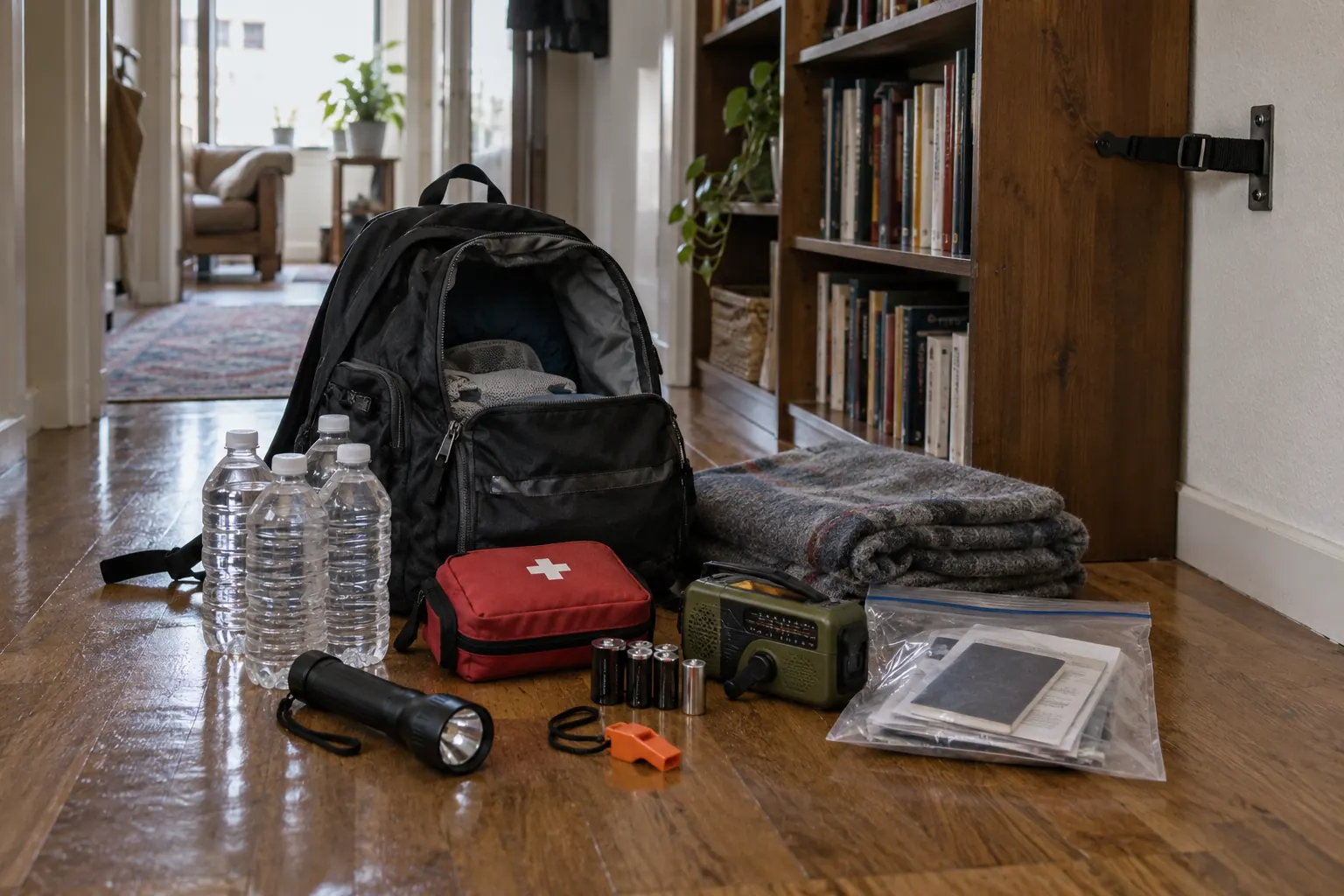
Red Cross guidelines emphasize maintaining a 72-hour emergency kit for each household member. This duration accounts for the typical time required for emergency services to become available and supply chains to normalize after major earthquakes. Your kit should include:

  • Water: One gallon per person per day for at least 3 days (total: 3 gallons per person). Store in food-grade containers in a cool location; rotate supply every 6 months
  • Non-perishable food: High-calorie, non-refrigerated items (nuts, dried fruit, canned goods, granola bars, crackers, peanut butter); include manual can opener; avoid high-sodium items
  • First aid kit: Comprehensive kit including sterile gauze, adhesive bandages, antibiotic ointment, pain relievers, antacids, laxatives, antihistamines, and prescription medications
  • Prescription medications: 30-day supply in original containers with clear labels; maintain updated medication list; store in cool, dry location
  • Flashlight and batteries: LED flashlight (brighter, longer-lasting than incandescent) with extra batteries; include backup hand-crank flashlight
  • Radio: Battery-powered or hand-crank NOAA Weather Radio for emergency updates and alerts
  • Important documents: Copies of identification, insurance policies, medical records, bank account information; store in waterproof container
  • Cash and credit cards: ATMs and credit card systems often fail after major earthquakes; maintain at least $500 in small denominations ($20 bills and smaller)
  • Multi-tool or utility knife: For cutting debris and other emergency tasks
  • Wet wipes, toilet paper, and hygiene items: Essential if water and sewage systems are disrupted

Store kits in multiple locations: one at home (easy to access), one at your workplace, and one in your vehicle. Use clear labeling and protect items in waterproof containers. Rotate perishable items (water, food, medications) every 6-12 months.

Step 8: Develop a Family Communication Plan

Earthquakes often overwhelm cellular networks, making it impossible to reach family members immediately. Establish a pre-arranged communication strategy:

  • Out-of-area contact: Designate a family member or trusted friend outside your region as the primary contact point. Local networks may be overwhelmed, but long-distance calls sometimes succeed when local systems fail. Ensure all family members know this person's phone number and email.
  • Meeting points: Establish a primary meeting location (neighborhood park, school, or landmark) and secondary location outside your area if your neighborhood is unsafe. Include a map with marked locations.
  • School/workplace procedures: Ensure children know to shelter in place at school after an earthquake; obtain contact procedures from schools. Identify safe locations at your workplace and establish a meeting plan with colleagues.
  • Identification: Consider medical alert bracelets or ID cards listing blood type, medical conditions, emergency contact, and out-of-area contact number for all family members.

Part 4: Family Preparedness Drills

Step 9: Practice Drop-Cover-Hold On Drills

The Drop-Cover-Hold On technique, endorsed by the United States Geological Survey (USGS) and American Red Cross, is the scientifically recommended response during earthquake shaking:

  • Drop: Immediately drop to hands and knees when shaking begins or you feel an earthquake
  • Cover: Take shelter under a sturdy desk, table, or against an interior wall (not a window); protect your head and neck with your arms
  • Hold on: Hold your position until shaking stops, typically 30-60 seconds; do not run outside

This technique is far more effective than the outdated "Triangle of Life" method. Most earthquake-related injuries result from falling objects or the person falling; taking cover under a sturdy object provides maximum protection. Conduct quarterly drills with your entire family, including children and elderly members. Practice identifying safe locations in each room of your home, workplace, and school.

Step 10: Establish Workplace and School Safety Plans

Earthquakes occur randomly, meaning you may not be home when one strikes. Ensure safety planning extends to all locations where family members spend significant time:

  • Workplace: Participate in organizational earthquake drills; identify safe locations in your building; know evacuation procedures and meeting points; establish communication plan with coworkers
  • Schools: Verify that schools conduct regular earthquake drills and maintain emergency supplies; understand school procedures for reunification after major earthquakes; ensure your child knows the Drop-Cover-Hold On technique
  • Childcare facilities: Review emergency procedures; ensure facility maintains emergency supplies and first aid capabilities; provide your emergency contact information

Part 5: Financial Protection and Documentation

Step 11: Secure Comprehensive Earthquake Insurance

Standard homeowner's insurance does not cover earthquake damage. In Turkey, earthquake insurance through DASK (Turkish Catastrophe Insurance Pool) is mandatory for all residential properties with mortgages. Key details include:

  • DASK coverage scope: Covers structural damage and permanent deformations to the building; does not cover contents, business interruption, or temporary housing
  • Coverage limits: Based on building replacement value; deductible of 10% of loss with minimum 40 million TL
  • Supplemental insurance: Consider additional private insurance for contents, valuable items, business interruption, and temporary housing
  • Policy review: Verify coverage is current; update replacement value estimates as costs rise; maintain policy documents in your emergency kit

In other seismic regions, homeowner's earthquake insurance is optional but highly recommended. Policy costs typically range from 0.5-2% of property value annually, providing critical financial protection for one of your most valuable assets.

Step 12: Document Your Property and Create Backup Records

Comprehensive documentation enables faster insurance claims and disaster recovery:

  • Home inventory: Photograph or video every room, including closets and storage areas; document all contents with estimated values; maintain detailed list of jewelry, art, electronics, and valuable items
  • Important documents: Create copies of government ID, birth certificates, marriage certificates, medical records, vaccine records, insurance policies, property deeds, mortgage documents, bank account information, and tax returns
  • Digital backups: Store copies in cloud services (Google Drive, Dropbox, iCloud) accessible from multiple devices; maintain encrypted password manager with account access information
  • Physical copies: Keep sealed envelope with key documents in safe deposit box at bank; maintain copies in your emergency kit
  • Update frequency: Review and update inventory annually or when making significant property improvements or acquisitions

Advanced Protection: Seismic Isolation and Building Strengthening

Beyond the 12 essential steps, property owners in high-seismic zones should consider advanced protection measures. Seismic isolation represents the ultimate earthquake protection technology, particularly for critical facilities and high-value properties.

Seismic isolation systems physically decouple the building from ground motion by introducing elastomeric or friction bearings between the foundation and superstructure. During earthquakes, these bearings allow the building to move independently of ground acceleration, dramatically reducing forces transmitted to the structure. Benefits include:

  • Reduction of seismic forces by 50-70% compared to fixed foundations
  • Minimal internal damage despite intense ground shaking
  • Improved occupant safety and comfort during earthquakes
  • Faster recovery and minimal business interruption after earthquakes

Additional building strengthening options for existing structures include:

  • Base isolation retrofitting: Retrofit existing buildings by inserting isolation bearings at foundation level
  • Shear wall installation: Add reinforced concrete shear walls to improve lateral strength
  • Moment connection upgrades: Strengthen steel beam-to-column connections to improve ductility
  • Soft story elimination: Add bracing or walls to eliminate dangerous soft story conditions
  • Foundation anchoring: Secure unreinforced masonry buildings to foundations with steel cables

Community Preparedness and Neighborhood Response

Individual and family preparedness provides critical protection, but community-level response dramatically improves disaster recovery. Consider participating in or establishing:

  • CERT programs: Community Emergency Response Teams (CERT) provide disaster response training and organize neighborhood mutual aid networks
  • AFAD coordination: In Turkey, AFAD (Disaster and Emergency Management Authority) coordinates disaster response; participate in community awareness programs
  • Neighborhood information: Create a neighborhood communication tree to establish contact after earthquakes; exchange emergency contact information with nearby residents

References and Further Reading

This article references the following authoritative sources:

  • FEMA P-154: Rapid Visual Screening of Buildings for Potential Seismic Hazards
  • FEMA E-74: Reducing the Risks of Nonstructural Earthquake Damage
  • American Red Cross: Earthquake Safety Guidelines and Emergency Preparedness
  • ASCE 7-22: Minimum Design Loads and Associated Criteria for Buildings and Other Structures
  • Applied Technology Council (ATC-20): Post-Earthquake Safety Evaluation of Buildings
  • U.S. Geological Survey: Earthquake Science and Preparedness Resources
  • Turkish Catastrophe Insurance Pool (DASK): Earthquake Insurance Coverage Guidelines
  • AFAD: Turkey Earthquake Risk Assessment and Preparedness Resources

Conclusion

Earthquake preparedness is not a one-time task but an ongoing commitment to protecting your family and property. Start with the first step: assessing your building's seismic vulnerability through professional structural evaluation. Each subsequent step builds comprehensive protection across structural safety, emergency response, financial security, and community resilience. The investment in preparation—typically a few thousand dollars for most households—pales in comparison to the life-saving benefits and rapid recovery these measures provide when earthquakes strike. The difference between chaos and safety often comes down to whether you prepared. Begin today.

Ready to protect your building? Get your free seismic risk analysis and understand your building's earthquake vulnerability.

What is Your Building's Earthquake Risk?

Get a location-specific risk analysis in 5 minutes. Detailed report based on AFAD data.

Free Analysis

🌐 Also available in Turkish: Deprem Öncesi Hazırlık: 12 Kritik Adım on sismikizolasyon.com

Share:

Free Earthquake Risk Analysis

Find out your building's seismic isolation needs in 2 minutes. Free analysis with real seismic data.

Start Free Analysis →