How Long Do Seismic Isolators Last? What Owners Should Expect
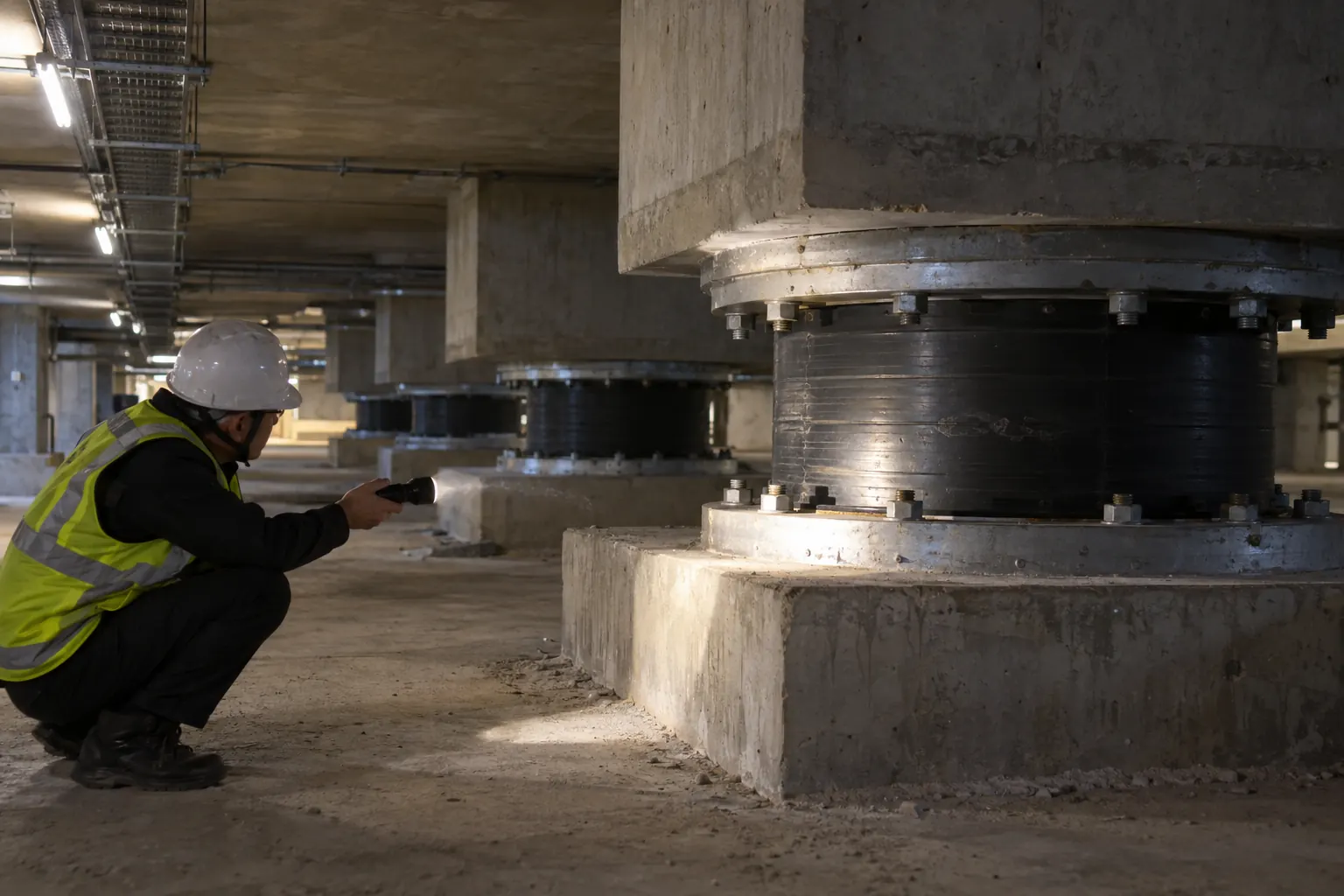
When an owner first hears that their building will sit on isolation bearings, the next question is almost always the same: how long do those bearings last, and will someone have to jack the building up and replace them in thirty years?
It is a fair question, and most of the answers circulating online are invented. You will find tables claiming lead rubber bearings last 50 to 100 years while friction pendulum bearings last 30 to 50. None of those numbers come from a code or a standard. The real answer is simpler, and better.
The short answer
Standards do not assign isolators a life in years. They require the isolator to have the same design working life as the structure it supports, and they make the manufacturer prove it through testing. For buildings, that design working life is typically 50 years. The bearing is engineered to outlast the mortgage, and that engineering is verified before the first unit ships.
There is no replacement schedule. There is an inspection program. Those are different things, and confusing them is what produces bad life cycle cost estimates.
What the standards actually require
In the United States, isolation systems are designed under ASCE 7-22 Chapter 17, which sets out a prototype and production test protocol: each bearing type is tested through a defined sequence of cycles at design displacement, and production units are sampled and tested again. Europe uses EN 15129 for antiseismic devices, with ISO 22762 covering elastomeric bearings specifically.
On durability, these standards take the same approach: instead of naming a number of years, they measure how the material changes over time under accelerated conditions. For elastomeric bearings the typical battery includes:
- Accelerated air oven ageing. Samples are held at elevated temperature for a defined period, compressing decades of oxidation into weeks. Hardness, tensile strength and elongation must stay within acceptance limits afterward.
- Compression set. How much permanent deformation the rubber retains under sustained load.
- Stress relaxation. Loss of stress at constant strain over time.
- Ozone and UV resistance. For any surface exposed to the environment.
A product that fails these cannot be used on the project. That is where the durability guarantee actually lives, not in a marketing line about service life.
Why nobody publishes a straight number
Because the governing variable is not the bearing type. It is the environment the bearing lives in. The same lead rubber bearing ages one way in a conditioned basement isolation level and another way on an exposed coastal foundation. What actually drives it:
- Temperature. The single biggest driver of rubber oxidation rate. Cool and stable means slow.
- Oxygen and ozone exposure. An enclosed isolation level is far more protective than an open substructure.
- Sustained compressive stress. Higher design stress means more compression set over the life of the building.
- Corrosion environment. The rubber is not the vulnerable part; the steel shims, end plates and anchorage are, particularly near salt spray or in deicing zones.
- Seismic history. If the building has taken a design level event, the bearings have gone through large displacement and that triggers an extraordinary inspection, not a scheduled one.
A serious specification therefore states the life as acceptance criteria rather than years: effective stiffness shall not deviate more than a stated percentage from the baseline, hardness shall not change more than a stated number of Shore A points, and so on. Inspection measures those values and the decision follows the measurement.
What the field record shows
Seismic isolation has been in service since the late 1960s, so there is now real ageing data rather than extrapolation. Bearings removed from early installations and tested in the laboratory show that properly compounded elastomeric bearings kept in a protected environment remain within acceptance limits after decades. The usual pattern is a modest increase in stiffness and hardness in the early years, then a plateau.
There is no widespread case of a building having its entire isolation system replaced because of ageing. The replacement cases on record trace back to design or manufacturing defects, or to environments the bearing was never specified for.
So what does maintenance actually mean
It does not mean swapping bearings on a timer. It means three distinct activities.
1. Commissioning inspection
Performed once the structure is fully loaded onto the isolators. The purpose is to record baseline values: elevation of each bearing, out of plumb, any visible imperfection. Without this record, every later inspection has nothing to compare against. It is the most commonly skipped step, and skipping it means that twenty years later nobody can say whether a deformation is new or was there on day one.
2. Periodic visual inspection
Interval is set by the project specification. What gets checked:
- Cracking, tearing or bulging in the rubber
- Corrosion on steel plates, shims and anchor bolts
- Condition of protective coatings
- Permanent out of plumb displacement
- Whether the isolation gap is still clear
3. Inspection after an earthquake
Triggered when ground motion exceeds a threshold defined in the specification. The question being asked is whether residual displacement and recentering behavior are still within tolerance.
The thing that actually fails: the isolation gap
Over a building lifetime, the item most likely to disable an isolation system is not the bearing. It is the moat.
An isolated building is designed to move horizontally during an earthquake, which is why it is surrounded by a clear gap. That gap gets filled over the years without anyone registering what they are doing. A utility line is run across it. A ramp is poured. A planter is set in place. It becomes storage. The building ends up mechanically tied to the ground at one point, and the entire system is bypassed.
This is far more common than bearing degradation and far cheaper to prevent. The operations manual handed to facilities management should state plainly what the gap is for, and gap clearance should be the first line item on every inspection checklist.
What inspection costs
The inspection itself is not an expensive line item. A technician works through the isolation level with visual checks and simple measuring equipment. The real cost driver is whether the inspection is possible: if access to the isolation level, lighting and working clearance around each bearing were not considered during design, providing them afterward costs more than the inspections ever will.
Which means the right time to discuss maintenance cost is during design, not after occupancy.
What to put in the supply contract
As the owner, insist that the bearing supply agreement includes:
- Prototype test reports, including ageing, compression set and relaxation results with the acceptance criteria stated alongside.
- Production test records from the actual batch going into your building. Prototype tests may have been run on a different production run.
- Commissioning survey report establishing baseline values.
- Inspection manual stating what is checked, at what interval, and what measured value triggers action.
- Spare unit commitment, so that if a single bearing ever needs replacing, an equivalent unit can still be manufactured.
- Access requirement written into the architectural and MEP drawings, so the isolation level stays inspectable.
Those six clauses determine the real service life of the system. They are worth considerably more than a datasheet claiming a sixty year life.
Conclusion
Isolators are designed to last the design life of the structure and that design is verified by test. There is no replacement schedule, there is an inspection program. What puts the system at risk over decades is not rubber chemistry. It is missing baseline records and a moat that quietly filled up.
If you want this set up properly on your project, book a call and we will go through how inspection access is handled in your current drawings and what is missing from the supply agreement.
Frequently Asked Questions
How long do seismic isolators last?
Standards do not assign a life in years. They require the isolator to have the same design working life as the structure, typically 50 years for a building, verified through accelerated ageing tests. Long term field data shows bearings in protected environments remaining within acceptance limits after decades of service.
Do isolators have to be replaced on a schedule?
No. There is no scheduled replacement. There is periodic inspection, and if measured values fall outside the acceptance criteria, a decision is made for that specific bearing.
Do lead rubber bearings last longer than friction pendulum bearings?
There is no standard or widely accepted dataset showing a service life difference between them. Selection is driven by target period, displacement demand, vertical load and recentering requirements, not by life expectancy. They do have different maintenance items: elastomeric bearings are watched for rubber and steel shim condition, sliding bearings for the sliding surface and its protective seal.
What does isolator maintenance cost?
The inspection work itself is modest. The cost driver is whether access to the isolation level was designed in. Retrofitting access after occupancy costs more than the inspections themselves.
Do isolators need checking after an earthquake?
Yes, once ground motion exceeds the threshold set in the project specification. The inspection checks residual displacement and whether recentering behavior is still within tolerance.
Similar Articles
Seismic Isolator Specifications and Testing: What to Require in Your RFQ
The document that protects an owner in an isolator purchase is the specification. Prototype vs production testing, EN 15129,...
Read articleIsolator TypesFriction Pendulum and Sliding Isolation Systems Explained
How friction pendulum bearings work, where sliding systems outperform elastomeric ones, and the design variables that drive...
Read articleStructural DurabilityHow Long Does a Reinforced Concrete Building Last?
Concrete buildings do not expire, they corrode at a rate set by cover, mix design and exposure. What governs service life, how...
Read article